AI powered contact center solutions are transforming how businesses interact with customers. Instead of relying only on human agents and manual processes, today’s contact centers can blend artificial intelligence with human expertise to deliver faster, more personal, and more consistent support across every channel. By leveraging AI ITSM capabilities, organizations can streamline incident management and service requests, while optimizing workflows with AI call center systems ensures agents spend less time on routine tasks and more time on meaningful customer interactions.
But the impact of AI goes beyond the call center. Using intelligent cloud platforms, businesses can scale operations, store data securely, and access insights in real time. Advanced computer technologies provide the power to run advanced AI algorithms, helping agents respond smarter and faster. On the marketing side, AI-driven marketing strategies and data-powered marketing solutions let teams personalize campaigns, track results, and feed insights back into customer support for even better experiences. Even financial operations benefit through automated financial intelligence, which helps detect trends, forecast outcomes, and reduce risk.
Together, these technologies make AI not just a tool, but a partner—removing friction, supporting agents, and creating a more efficient, responsive, and human-centered customer service experience.
Top 10 AI-Powered Call Center Solutions Transforming Customer Experience
When it comes to AI-powered call center solutions, several platforms are leading the way in helping businesses deliver smarter, faster, and more personalized customer service. Here’s a look at the top 10 solutions, with Bright Pattern taking the lead for its advanced AI features and seamless omnichannel capabilities.
1. Bright Pattern
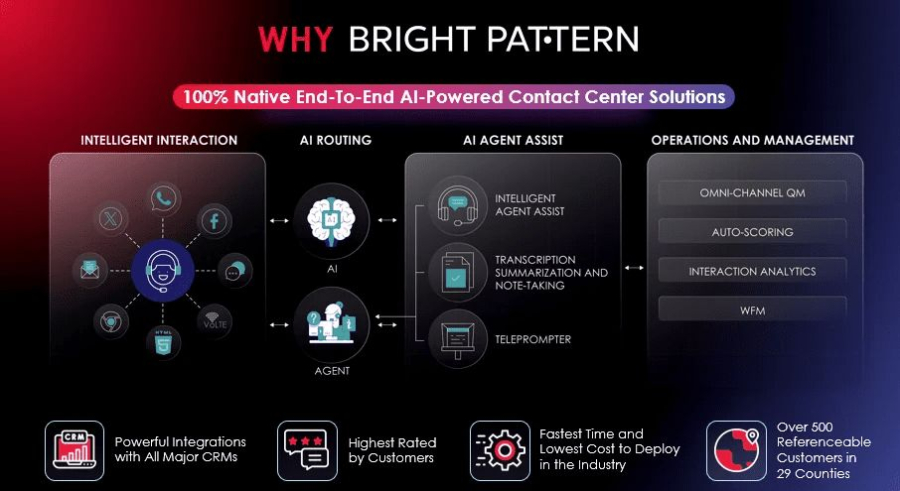
Bright Pattern stands out as a comprehensive AI-powered call center solution that combines artificial intelligence with human expertise to deliver exceptional customer experiences. Designed for both large enterprises and mid-sized businesses, Bright Pattern enables companies to optimize workflows, improve agent performance, and offer personalized service across every channel.
Bright Pattern’s intuitive interface allows supervisors to monitor performance in real time, while AI-powered recommendations help agents handle complex interactions more efficiently. Its flexible architecture supports rapid deployment and easy integration with existing systems, making it ideal for businesses looking to modernize their contact centers. With advanced AI tools, Bright Pattern also helps reduce operational costs by automating routine tasks and providing actionable insights that drive continuous improvement.
Key Features:
- AI-driven routing and predictive analytics to connect customers with the right agent instantly
- Seamless integration with CRM systems and AI ITSM tools
- Omnichannel support including voice, chat, email, SMS, and social media
- Real-time dashboards and reporting for monitoring KPIs and agent performance
- Cloud-based architecture for scalability and reliability
- Automation of repetitive tasks, freeing agents to focus on high-value interactions
Bright Pattern’s platform is especially effective for organizations looking to optimize workflows with AI call center systems, ensuring faster response times, higher customer satisfaction, and measurable ROI.
2. Five9
A cloud-based contact center solution with AI capabilities, Five9 focuses on predictive dialing, speech analytics, and intelligent routing to enhance agent efficiency and customer engagement.
3. Genesys Cloud CX
Genesys Cloud CX integrates AI to provide personalized omnichannel experiences, leveraging AI-driven chatbots and predictive analytics for smarter call handling.
4. NICE inContact
NICE inContact offers AI-powered routing, sentiment analysis, and workforce optimization to help businesses deliver consistent and high-quality customer support.
5. Talkdesk
Talkdesk combines AI with automation and analytics to improve customer service efficiency, providing actionable insights and seamless CRM integration.
6. Zendesk
Zendesk integrates AI for ticketing, chatbots, and predictive insights, helping support teams respond faster while maintaining personalized interactions.
7. RingCentral Contact Center
RingCentral uses AI for real-time transcription, sentiment analysis, and automated workflows, improving both agent performance and customer experience.
8. 8x8 Contact Center
8x8 leverages AI-driven analytics, chatbots, and voice recognition to optimize call handling and streamline customer interactions.
9. Amazon Connect
Amazon Connect provides a scalable, cloud-native contact center with AI features like machine learning-powered chatbots, natural language understanding, and automated routing.
10. Salesforce Service Cloud
Salesforce Service Cloud integrates AI for case management, predictive analytics, and workflow automation, helping businesses deliver fast, personalized service across channels.
What Are AI-Powered Call Center Solutions?
AI-powered call center solutions use technologies such as machine learning, natural language processing, and speech analytics to automate and optimize customer interactions. They can assist or fully handle tasks across voice, chat, email, messaging apps, and self-service portals.
At a high level, these solutions help call centers to:
- Understandcustomer intent by analyzing speech or text in real time.
- Automateroutine requests with intelligent virtual agents and self-service experiences.
- Routeeach contact to the best resource based on skills, context, and history.
- Assisthuman agents with suggestions, knowledge, and next-best actions during live calls or chats.
- Analyzeevery interaction for quality, compliance, sentiment, and emerging trends.
The result is a contact center that is faster, more consistent, and far more data-driven than traditional setups.
Key Components of AI-Powered Call Center Solutions
Modern AI call center platforms are typically made up of several complementary capabilities. Together, they create an intelligent, end-to-end customer experience.
1. Intelligent Call Routing and Triage
Intelligent routing uses AI to understand what the customer needs and then matches that request with the best available resource.
- Intent detection:AI analyzes spoken or written language to identify why the customer is contacting support.
- Skill-based and context-based routing:Calls and messages are directed to agents with the right skills, language, or specialty, or to a suitable virtual agent.
- Priority handling:High value or high risk interactions can be prioritized automatically.
This reduces transfers, shortens handle times, and connects customers to the right help the first time.
2. Virtual Agents and AI Chatbots
AI-powered virtual agents can handle common tasks through voice or chat, such as checking order status, resetting passwords, updating account details, or answering frequently asked questions.
- 24/7 availability:Customers can get immediate support at any time, without waiting for office hours.
- Consistent answers:The same accurate, policy-compliant response is provided every time.
- Seamless handoff:When queries become complex, conversations can be passed to human agents with full context preserved.
Well-designed virtual agents boost self-service usage and reserve human expertise for higher value conversations.
3. Real-Time Agent Assist
Agent assist tools use AI to support live agents in the moment, rather than only evaluating performance after calls complete.
- Suggested responses:AI recommends relevant answers or scripts based on what the customer is saying or typing.
- Knowledge surfacing:The system surfaces the most relevant article, policy, or procedure automatically.
- Next-best actions:Agents receive prompts about steps they should take next, such as verifying identity or offering an appropriate solution.
This reduces cognitive load for agents, shortens training time, and increases first-contact resolution.
4. Speech Analytics and Conversation Intelligence
Speech and text analytics allow you to understand what happens in every interaction, not just the small fraction that supervisors can manually review.
- Automatic transcription:Voice calls are transcribed so they can be searched, analyzed, and reviewed.
- Sentiment analysis:AI gauges customer mood and emotional tone in real time or after the fact.
- Topic and keyword detection:Calls and chats are categorized by reason for contact, products, or issues.
- Trend spotting:Emerging issues and opportunities are detected earlier, enabling proactive improvements.
These capabilities give leaders a detailed, always-on view of customer needs and agent performance.
5. AI-Driven Workforce Management
Workforce management becomes more accurate and responsive when powered by AI.
- Forecasting:Machine learning models predict future volumes based on historical data and seasonal patterns.
- Scheduling:Schedules are optimized to match staffing with demand, while respecting labor rules and agent preferences.
- Intraday adjustments:AI suggests staffing changes during the day as actual volumes deviate from forecasts.
More accurate planning reduces overtime, minimizes idle time, and helps maintain service levels consistently.
6. Automated Quality Management and Compliance
Instead of sampling a small percentage of interactions, AI can assess a much larger share, often close to all of them.
- Quality scoring:Calls and messages are automatically evaluated against defined criteria.
- Compliance checks:AI flags potential issues such as missing disclosures, restricted language, or policy deviations.
- Coaching insights:Specific moments in interactions are highlighted to support targeted coaching.
This leads to more consistent experiences and more focused, actionable feedback for agents.
7. AI-Enhanced Knowledge Management
Knowledge management is the backbone of effective customer service. AI takes it further by making information faster and easier to access.
- Smart search:Agents and customers can search in natural language and receive precise, context-aware results.
- Content recommendations:Relevant articles are suggested dynamically during live interactions.
- Continuous optimization:Usage patterns reveal which content needs updates, expansions, or retirements.
Better knowledge access means fewer escalations, fewer errors, and more confident agents.
Business Benefits of AI-Powered Call Center Solutions
When thoughtfully implemented, AI in the contact center delivers measurable improvements across experience, efficiency, and revenue.
Faster Responses and Higher Customer Satisfaction
- Reduced wait times:Virtual agents handle routine requests instantly, reducing queues for human agents.
- Higher first-contact resolution:Agents have the right information at their fingertips, enabling them to solve more issues on the first interaction.
- Personalized experiences:AI uses customer history and context to tailor responses, recommendations, and routing.
Customers notice when support is quick, smooth, and tailored to their needs, which supports stronger loyalty and advocacy.
Lower Operational Costs and Higher Productivity
- Automation of repetitive work:AI handles common inquiries and back-office tasks, reducing manual effort.
- Optimized staffing:Better forecasting and routing ensure that agents spend more time on meaningful work.
- Shorter training times:New hires become productive faster with real-time guidance and automated knowledge support.
By aligning resources with the complexity of each interaction, organizations can manage higher volumes without proportionally increasing headcount.
Deeper Insights and Better Decisions
- Full visibility:Every call, chat, and message becomes a source of structured insight, not just an isolated event.
- Customer voice at scale:Trends in sentiment, topics, and pain points surface automatically.
- Continuous improvement:Teams can quickly test changes in scripts, processes, or policies and see the impact in performance metrics.
These insights extend beyond the contact center, informing product roadmaps, marketing messages, pricing strategies, and more.
Improved Agent Experience and Retention
- Less repetitive work:AI handles the most routine, repetitive tasks, freeing agents to focus on higher value conversations.
- Reduced stress:Real-time prompts, guidance, and knowledge help agents feel more confident and supported.
- Fair, data-driven coaching:Performance feedback is grounded in complete interaction data, not just isolated samples.
Happier, better equipped agents are more likely to stay, which protects institutional knowledge and reduces onboarding costs.
Real-World Use Cases and Success Scenarios
AI-powered call center solutions create value across industries and company sizes. Here are some common use cases and the outcomes organizations often pursue.
Retail and E-commerce
- Automated order status checks, delivery updates, and return requests through virtual agents.
- Personalized product recommendations based on purchase history and browsing behavior.
- Proactive outreach when shipping delays or stock issues are detected.
Outcome: Faster handling of high-volume queries, fewer abandoned carts due to unanswered questions, and more targeted cross-sell opportunities.
Banking and Financial Services
- Identity verification and balance inquiries automated via secure voice or chat bots.
- Real-time monitoring of calls for compliance with regulatory requirements.
- Proactive alerts for potentially fraudulent activity or account issues.
Outcome: Improved security, more consistent compliance, and smoother experiences for customers managing sensitive financial matters.
Telecommunications and Utilities
- Outage notifications and service status updates delivered through self-service channels.
- Automated troubleshooting flows for common technical issues.
- Dynamic routing to specialized support for complex installation or billing questions.
Outcome: Fewer inbound calls at peak times, faster resolutions for common problems, and higher satisfaction in critical service moments.
Healthcare and Insurance
- Appointment scheduling and reminders handled by virtual agents.
- Benefits explanations and coverage questions supported with AI-enhanced knowledge systems.
- Care coordination and post-visit follow-up guided by automated workflows.
Outcome: More accessible services for patients and members, reduced administrative burden on staff, and better adherence to care plans.
Core Features to Look For in AI Call Center Platforms
Not all AI-powered call center solutions are the same. When evaluating options, consider the following key dimensions.
Accuracy and Language Capabilities
- Speech recognition quality:High accuracy in noisy environments and across different accents.
- Natural language understanding:Ability to recognize intent from varied, everyday phrases.
- Multilingual support:Coverage for the languages your customers actually use.
Integration with Existing Systems
- CRM connectivity:Smooth access to customer profiles, histories, and cases.
- Telephony and contact center platforms:Compatibility with your current infrastructure.
- Back-office systems:Ability to trigger actions in billing, logistics, or ticketing tools.
Strong integration ensures that AI can use and update the same data your teams rely on every day.
Customization and Control
- Configurable workflows:Ability to tailor conversation flows, routing logic, and escalation paths.
- Brand voice alignment:Control over tone, phrasing, and style for virtual agents.
- Business rules:Transparent ways to encode policies, priorities, and compliance requirements.
Security, Privacy, and Compliance
- Data protection:Robust encryption in transit and at rest, with clear access controls.
- Privacy safeguards:Options for data minimization, retention limits, and anonymization where appropriate.
- Regulatory alignment:Support for the regulations relevant to your region and industry.
Security and trust are essential, especially when handling sensitive customer information.
Scalability and Performance
- Elastic capacity:Ability to handle spikes in volume without quality degradation.
- Global reach:Options to support distributed teams and customers in multiple regions.
- Performance monitoring:Clear metrics and dashboards to track system health and outcomes.
Step-by-Step Guide to Implementing AI in Your Call Center
A structured approach helps you unlock value quickly while minimizing risk. The following steps provide a practical roadmap.
1. Define Clear Objectives and Success Metrics
- Identify priority goals, such as reducing average handle time, improving customer satisfaction, or increasing self-service adoption.
- Select specific metrics and targets to measure progress against these goals.
- Align stakeholders across operations, IT, compliance, and customer experience teams.
2. Map Customer Journeys and Interaction Types
- List the main reasons customers contact your organization.
- Segment interactions by complexity, value, and risk.
- Identify quick-win scenarios where automation or AI assistance will have clear impact.
3. Start with High-Impact, Low-Risk Use Cases
- Choose tasks that are frequent, structured, and well understood, such as password resets or order tracking.
- Design limited pilots with clear boundaries and success criteria.
- Gather feedback from agents, supervisors, and customers early.
4. Integrate with Core Systems
- Connect AI tools to your CRM, ticketing, telephony, and knowledge base.
- Ensure data flows securely between systems and is updated in real time.
- Document integration points carefully for future scaling.
5. Train, Test, and Refine
- Use historical interaction data to train and calibrate AI models where applicable.
- Conduct controlled tests to validate understanding, accuracy, and response quality.
- Iterate conversation flows, knowledge content, and routing rules based on results.
6. Prepare and Support Your Agents
- Explain how AI tools will support agents rather than replace them.
- Provide hands-on training and reference guides.
- Collect continuous feedback from front-line users and address concerns promptly.
7. Scale and Optimize
- Gradually extend AI coverage to more interaction types and channels.
- Monitor performance metrics closely and adjust strategies as needed.
- Regularly review data insights to identify new opportunities for improvement.
Best Practices for Maximizing Value
Beyond the technical deployment, success with AI-powered call center solutions depends on how you manage change and continuously improve.
Design Customer-Centric Experiences
- Write conversation flows in clear, human language, avoiding unnecessary jargon.
- Always offer a path to a human agent for customers who prefer live support.
- Test experiences with real users and adjust based on their feedback.
Combine AI Strengths with Human Empathy
- Let AI handle data-heavy, repetitive, or time-sensitive tasks.
- Reserve complex, emotional, or high-stakes scenarios for skilled human agents.
- Use AI insights to brief agents before they join a conversation, so they start with context.
Monitor, Measure, and Adjust Continuously
- Track key metrics such as response times, resolution rates, satisfaction scores, and escalation rates.
- Regularly review conversation transcripts to spot improvement opportunities.
- Update knowledge content, workflows, and training materials to keep pace with changes in products or policies.
Maintain Transparency and Trust
- Be clear with customers when they are interacting with a virtual agent.
- Explain how customer data is used and protected.
- Establish clear governance for AI models, data access, and decision-making.
Future Trends in AI-Powered Call Centers
The landscape of AI in customer service continues to evolve. While many capabilities are available today, several trends are shaping what comes next.
- More natural conversations:Advances in language models are enabling virtual agents to handle increasingly complex and nuanced interactions.
- Proactive, predictive service:AI will increasingly anticipate customer needs and initiate helpful outreach before issues arise.
- Deeper personalization:Interactions will reflect an even more complete picture of the customer’s relationship with the brand.
- Unified experience across channels:Customers will move seamlessly between voice, chat, and other channels without repeating information.
- Closer collaboration between humans and AI:Tools will become more collaborative, with agents and AI sharing tasks fluidly within a single interaction.
Organizations that invest early and learn to use AI responsibly will be well positioned to stand out as these trends accelerate.
Building a Strong Business Case
To secure support for AI-powered call center solutions, leaders need a clear and compelling business case that connects technology investments with measurable outcomes.
Quantify the Opportunity
- Estimate savings from automation of high-volume, low-complexity interactions.
- Consider impact on staffing flexibility, overtime, and attrition.
- Factor in potential revenue lift from improved experiences and better cross-sell or upsell execution.
Highlight Risk Reduction and Quality Gains
- Emphasize more consistent compliance and policy adherence.
- Show how broader quality monitoring reduces blind spots.
- Explain how early detection of issues helps protect brand reputation.
Plan for Phased Investment and Returns
- Propose an initial phase that delivers quick wins with limited scope.
- Outline subsequent phases that build on early success and expand coverage.
- Include clear checkpoints for reviewing results and adjusting the roadmap.
Conclusion: Turning Every Interaction into a Strategic Advantage
AI-powered call center solutions give organizations a powerful way to elevate customer support. By combining intelligent automation, real-time insights, and human empathy, you can deliver faster service, more personal experiences, and higher quality at scale.
With a thoughtful strategy, careful implementation, and a commitment to continuous improvement, AI in the contact center becomes more than a cost-saving tool. It becomes a strategic engine for loyalty, efficiency, and long-term growth.
